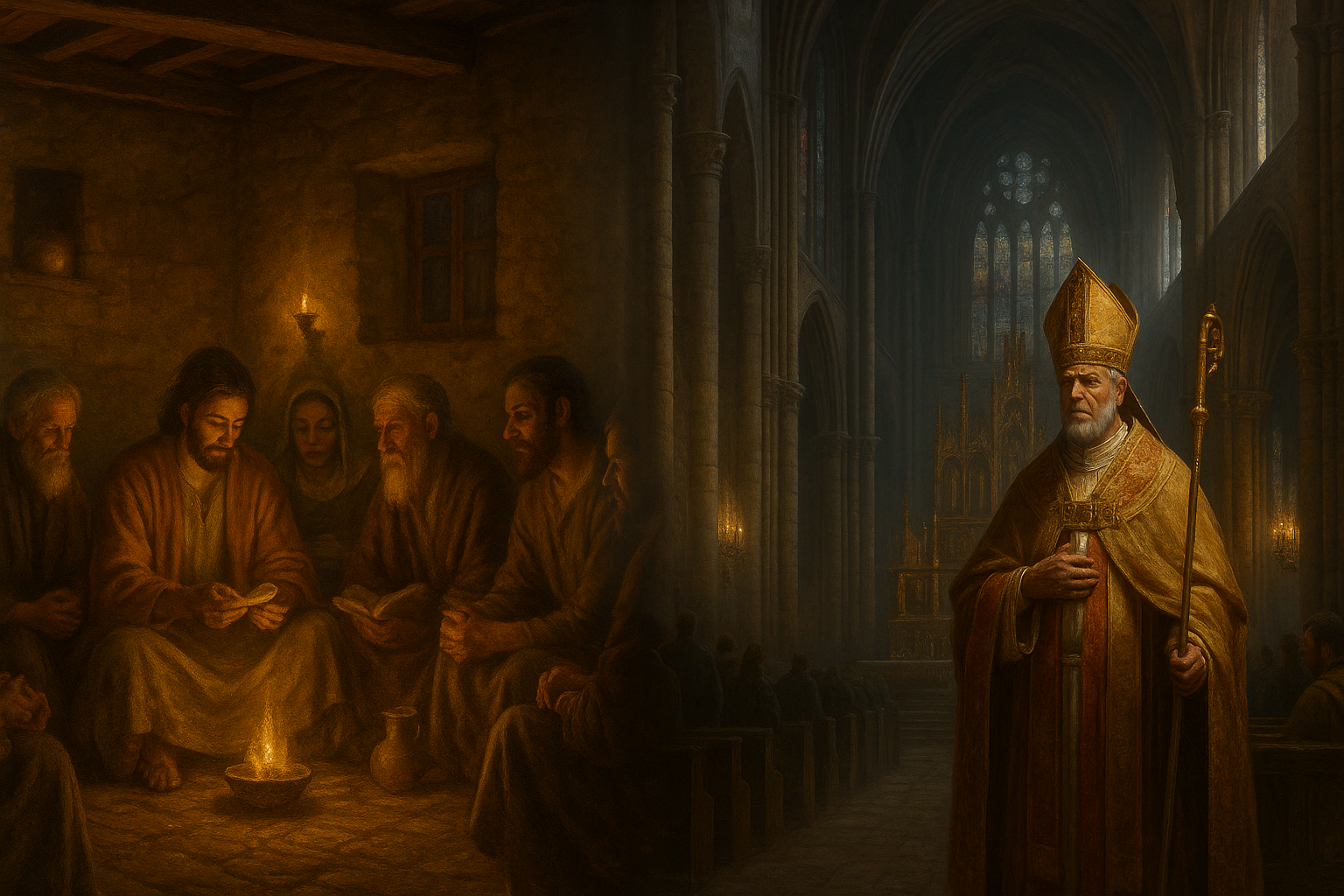
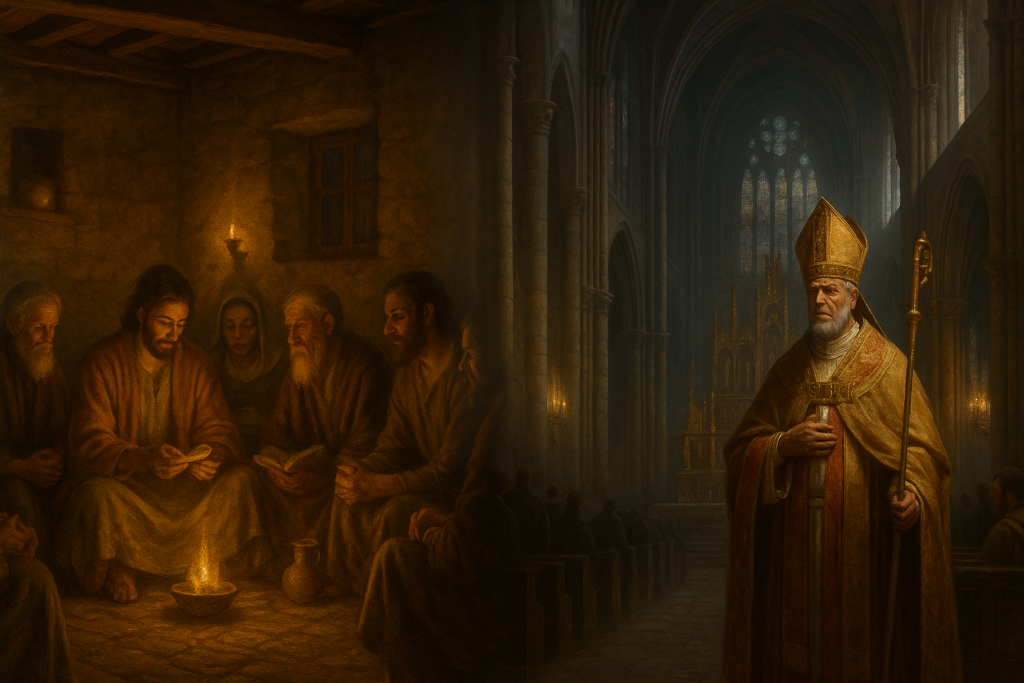
From the Early Church (30 AD – 100 AD) to the Modern Church — How Christianity Became Institutional (and What We Lost)
What the Early Church Looked Like (AD 30–100)
When Jesus said, “I will build My church, and the gates of Hades will not overcome it” (Matthew 16:18), He wasn’t talking about a cathedral, a denomination, or a political powerhouse.
The early church — the one we see in the book of Acts — was a Spirit-led family of believers. They met in homes, shared meals, prayed together, and spread the Gospel even when it cost them everything.
There were no stained-glass windows, no official hierarchies, no “Christian empire.” Just people who had encountered the risen Jesus and were filled with the Holy Spirit.
Persecution and Growth in the Early Church (AD 100–300)
For nearly three centuries, Christianity spread despite heavy persecution by the Roman Empire.
Followers of Jesus refused to worship the emperor or bow to the gods of the culture, and many were jailed, beaten or executed.
But early church history shows something remarkable: the more they were oppressed, the more they grew. Why? Because the real, biblical church is not a building — it’s people carrying God’s presence wherever they go.
Constantine and the Institutional Church (AD 313)
In AD 313, Emperor Constantine legalised Christianity through the Edict of Milan. Persecution ended — which sounded like a win — but it marked a major shift.
Christianity became institutionalised. Faith was tied to political power, and the church gained land, wealth, and influence. Leaders began to look more like imperial officials than servants, and the simplicity of worship gave way to grand ceremonies.
Worship moved from living rooms to basilicas, and ordinary believers began to depend on clergy for access to Scripture and sacraments.
From the Early Church to the Medieval Church (AD 400–1500)
Over the centuries, the medieval church emerged as a highly structured hierarchy — pope → bishops → priests → laity.
Latin became the language of worship, cutting most people off from reading Scripture for themselves. Political alliances shaped church decisions, and leaders had the authority to crown or depose kings.
Many of the freedoms and participatory gifts in the biblical church were replaced by ritual and control. Women, who played vital roles as leaders and teachers in the early church, were largely pushed out of visible ministry.
The focus shifted from spiritual gifts and discipleship to ritual, power, and control.
From the Reformation to the Modern Church (1500–2025)
The medieval church reached a breaking point with corruption, indulgences, and doctrines that had drifted far from Scripture. In the 1500s, reformers like Martin Luther and John Calvin called for a return to the Word of God. Luther’s 95 Theses (1517) sparked what became known as the Protestant Reformation.
For the first time in centuries, ordinary Christians could read the Bible in their own language, as translations spread across Europe. This was a major victory for biblical faith. But the Reformation also fractured Christianity into many denominations. Instead of one institutional church, thousands of groups emerged, each holding different interpretations of Scripture.
The Church in the Modern Era (1800s–1900s)
The next few centuries saw Christianity spread across the globe. Revivals and missionary movements carried the Gospel to the Americas, Africa, and Asia. Many came to faith, and new nations were shaped by Christian influence.
However with cultural acceptance came new dangers. In many places, Christianity became a tradition more than a transformation. People were “born Christian” by nation or culture, but they didn’t necessarily follow Christ as disciples. Churches grew in size and influence, but sometimes drifted into comfort, wealth, and nationalism.
The Contemporary Church (2000s–2025)
In the last century, churches have faced new challenges. Some have embraced technology and modern culture in powerful ways — preaching the Gospel worldwide through media and missions. Others have drifted into what Scripture calls lukewarm Christianity (Revelation 3:16).
Instead of making disciples of nations, many churches focus on attracting crowds. The message is often watered down to keep people entertained or to avoid offense. Faith becomes about consumption — programs, events, and personalities — rather than transformation through Jesus.
This has created a generation of churchgoers who know about Christianity but don’t necessarily know Christ. It’s the same warning we saw in the contrast between the early church vs medieval church: when the church loses sight of God’s Word and His Spirit, it becomes weak, divided, and powerless.
What Is Lukewarm Christianity?
In Revelation 3:15–16, Jesus warns the church in Laodicea:
“I know your deeds, that you are neither cold nor hot. I wish you were either one or the other! So, because you are lukewarm—neither hot nor cold—I am about to spit you out of my mouth.”
Lukewarm Christianity doesn’t burn with devotion to Christ, but it also doesn’t openly reject Him. It sits in the middle — claiming faith with words but denying it through actions.
A lukewarm Christian might say, “I believe in God” or “I follow Jesus,” but their life bears little or no fruit. They don’t practice what they preach, their priorities don’t reflect Scripture, and repentance is absent. Instead of turning from sin, they excuse it — believing that grace will cover what they refuse to surrender.
But God’s grace is not permission to keep sinning — it’s power to live free from sin. Paul makes this clear: “Shall we go on sinning so that grace may increase? By no means! How can we who died to sin still live in it?” (Romans 6:1–2).
Some signs of lukewarm Christianity include:
- Cultural faith — wearing the “Christian” label but living like the world.
- Selective obedience — following the easy parts of the Bible while ignoring the hard truths.
- Comfort over calling — choosing ease, safety, or success instead of carrying the cross daily.
- Shallow faith — belief in name only, without obedience or fruit; a dead faith that does not transform the life (James 2:17).
- Consumer mindset — asking, “What can I get?” instead of, “How can I serve?”
- Misusing God’s name — attaching”in the name of Jesus” to actions, teachings, or agendas He never commanded. This breaks the third commandment (Exodus 20:7), because it makes His holy name empty by using it in vain.
- Cheap grace — misunderstanding grace as a blanket that covers unrepentant sin, instead of receiving it as the transforming power to live holy.
This is the heart of lukewarm faith: claiming Christ without being changed by Him. It creates a powerless Christianity that confuses the world and deceives the believer into thinking they are safe when they are not.
The True Church
From Acts to the medieval church, through the Reformation and into today, one truth has not changed: Jesus never called us to build empires or institutions. He called us to make disciples of all nations (Matthew 28:19).
Much of what calls itself “church” today has blended into culture and grown lukewarm. But the true church has never been chained to cathedrals, denominations, or politics. It is the body of Christ — alive wherever His Spirit moves.
And that church — radical, Spirit-filled, and unstoppable — is still here today.
The question isn’t whether that church exists. The question is: are you part of it?